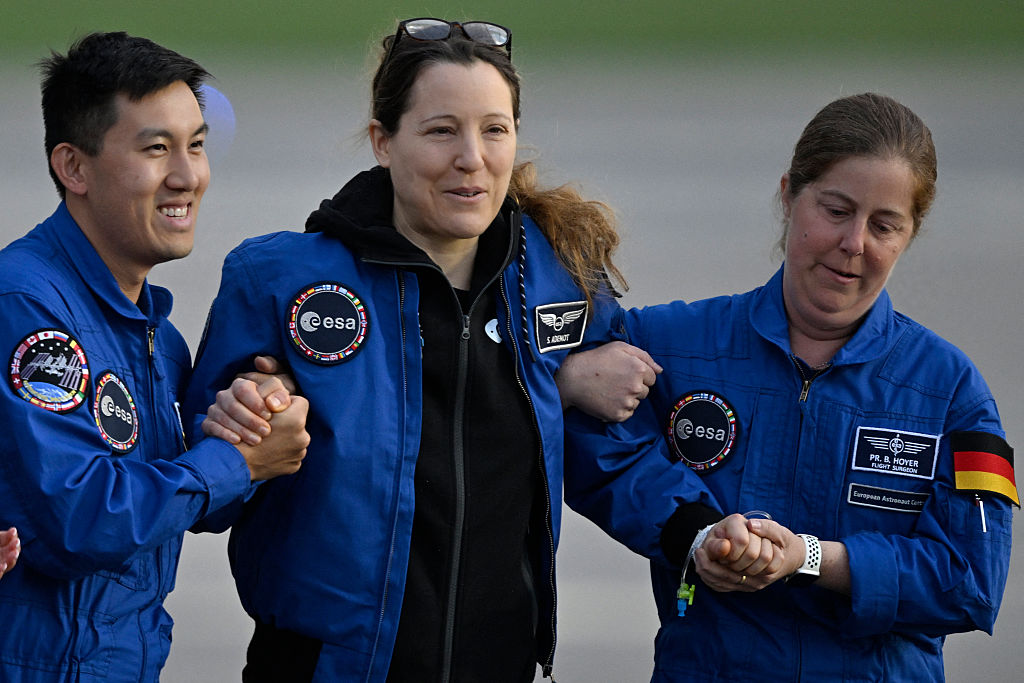
Human journey to Mars – His observation is based on this experience of the return to gravity. Sophie Adenot quickly compared her condition to the obstacles that would await a crew at the end of a journey to the red planet. In particular, it identifies two necessary advances: shortening the journey and maintaining a form of gravity on board.
A return to Earth revealing physical limits
After opening her capsule, Sophie Adenot suffered from the movement of the sea and from discomfort which made her wish to go back into space. This reaction preceded a reflection on the ability of astronauts to withstand an arrival after several months of travel.
Six to nine months of travel in a smaller space
The duration of a trip to Mars is currently estimated at between six and nine months, an order of magnitude comparable to its orbital stay. But this proximity in duration does not mean that the conditions would be equivalent for travelers.
In the ISS, Sophie Adenot had space to maintain her physical condition. A transport ship would provide a more restricted environment. She highlights this difference to explain why her experience constitutes a warning, even though she benefited from more favorable conditions.
“With the technology we currently have, a very long-term mission, a journey of several months to go to Mars, imagine the carnage,” she said. The risk she describes concerns physiological incapacities likely to complicate even basic movements after the journey.
Artificial gravity among the avenues considered
Sophie Adenot first mentions the need to speed up the journey. Reducing its duration is one of the technological breakthroughs that it considers essential before considering a human mission to Mars in better conditions.
She also cites a rotating space vehicle, which would expose astronauts to a form of artificial gravity. In this configuration, she considers that a trip could become possible. His remarks therefore distinguish the current limits from the possibilities opened up by new technologies.
However, these solutions remain steps to be taken, and not capabilities that it presents as already acquired. “But today, indeed, we still need a few key steps,” she stressed, placing the physical preparation of crews at the heart of the requirements of a future mission.
About the Author